Discover the soaring heights, flying buttresses, and architectural secrets of Germany's greatest Gothic cathedral.
Cologne Cathedral (Kölner Dom) is renowned as a monument of Christianity, of German Catholicism in particular, but also as a masterpiece of High Gothic architecture. When construction began in 1248, the master builder Gerhard von Rile modeled it after the French cathedrals of Amiens and Paris, but pushed the structural boundaries further to achieve unprecedented height and light.
Even though construction was halted in 1473 and the building remained unfinished for 400 years, the original medieval plans were strictly followed when work resumed in the 19th century. This makes the cathedral a unified, perfect expression of Gothic ideals despite taking 632 years to build.
The exterior of the cathedral is defined by its complex system of flying buttresses. These stone arches transfer the massive weight of the soaring vaulted ceilings outward and down to the ground. By taking the weight off the walls, the master builders were able to replace solid stone walls with massive, fragile stained glass windows.
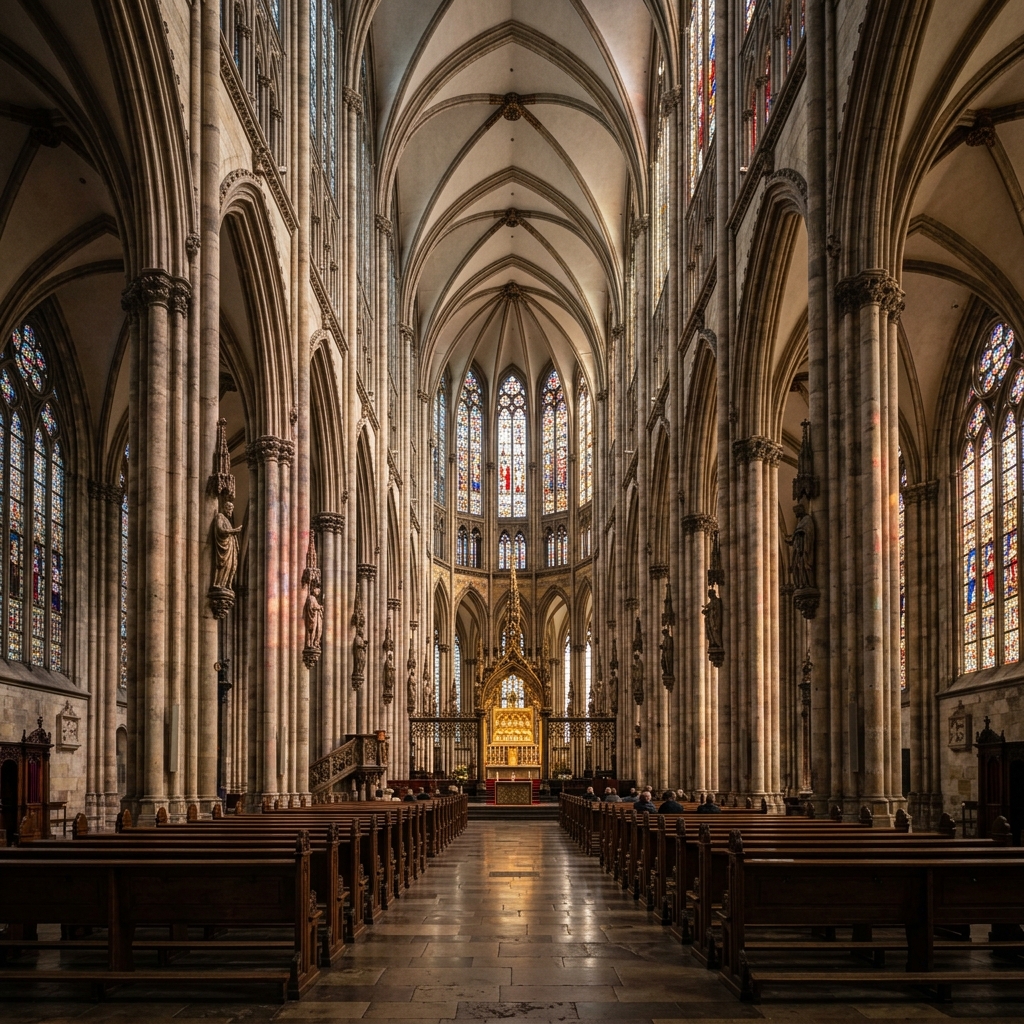
Looking up from the central nave, you see the intricate ribbed vaults. These intersecting stone ribs act as the structural "skeleton" of the ceiling. The highest vault reaches an astonishing 43.35 meters (142 feet) high, creating a feeling of verticality that draws the eye (and the soul) toward heaven—a primary goal of Gothic architecture.
The massive West Facade is dominated by two identical towers reaching 157 meters (515 ft) into the sky. Completed in 1880, they were briefly the tallest structures in the world. Their openwork spires, made of intricately carved stone tracery, reduce wind resistance and are a hallmark of German Gothic design.
More about the cathedral's height →The cathedral's footprint forms a massive Latin Cross. It consists of a long five-aisled basilica body (one central nave flanked by two smaller aisles on each side). This intersects with a projecting transept. The eastern end finishes in a choir with a seven-sided ambulatory surrounded by radiating chapels, heavily inspired by French cathedral layouts.
Cologne Cathedral is a prime example of High Gothic architecture. It was heavily influenced by the French Gothic style, specifically the Cathedral of Amiens, but built on an even grander scale.
The flying buttresses are essential to the Gothic design. They transfer the immense outward weight of the high, vaulted stone ceiling down to the ground. This takes the load off the walls, allowing them to be thin and filled with massive, beautiful stained glass windows instead of solid stone.
The cathedral was originally a light tan/grey color. The black exterior you see today is due to centuries of pollution, acid rain, and coal smoke reacting with the sandstone and trachyte. The cathedral workshop is constantly cleaning and replacing stones, but the dark patina remains a characteristic feature.
Though started in 1248, it was left unfinished for centuries. The original medieval plans were discovered in the 1800s, and the building was finally completed according to these original architectural designs in 1880.