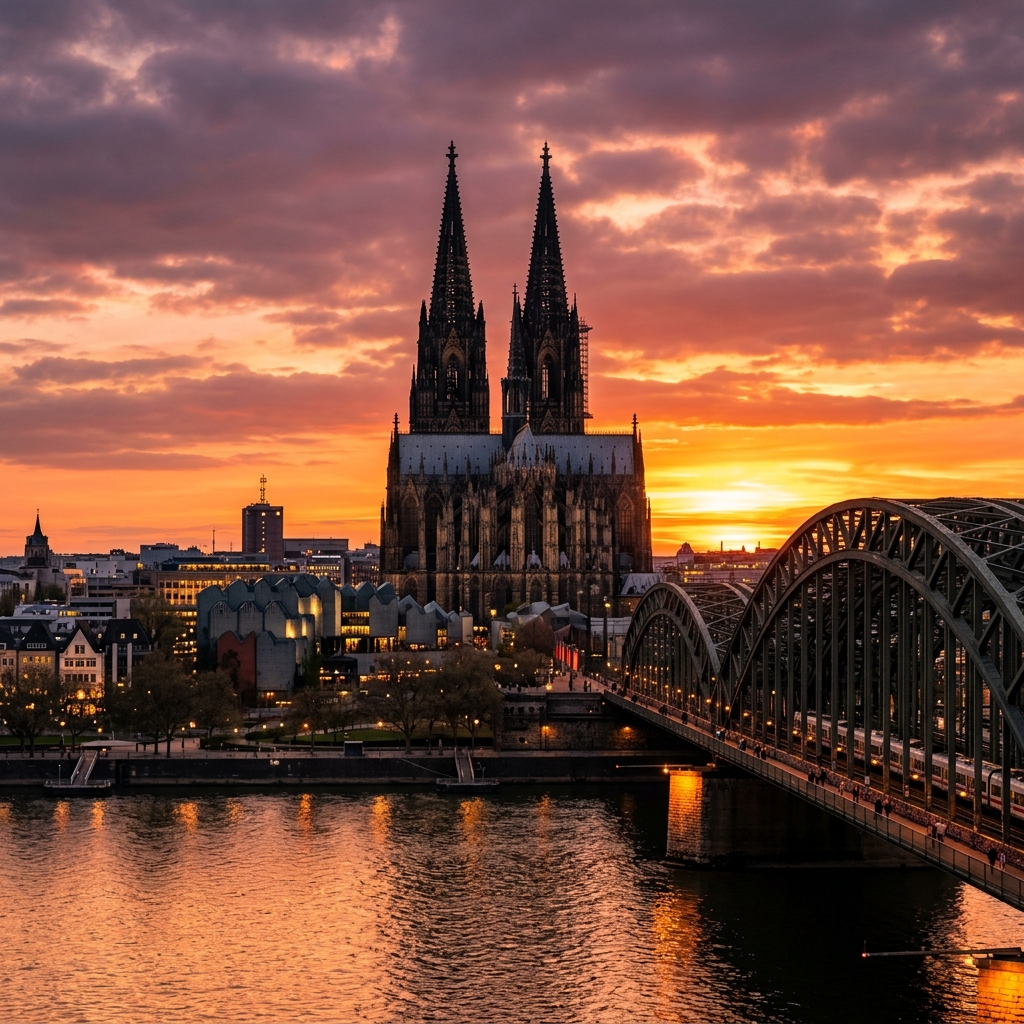
Cologne Cathedral at sunset — 157 meters of Gothic grandeur, completed in 1880 after 632 years
632 Years of Construction | 1248 - 1880
Cologne Cathedral (Kölner Dom) was begun on 15 August 1248 and completed on 15 October 1880 — 632 years. It survived 14 bomb hits in World War II and became a UNESCO World Heritage Site in 1996.
Last Updated: August 2026
Advertisement
1248
Foundation Laid
1880
Completed
632
Years to Build
157m
Height (516 ft)
The height of Cologne Cathedral is 157.22 metres (516 feet), making it one of the tallest churches in the world.
Cologne Cathedral at sunset — 157 meters of Gothic grandeur, completed in 1880 after 632 years
632 years. The foundation stone was laid on 15 August 1248 and completion was celebrated on 15 October 1880. Building was not continuous: roughly 225 years of medieval work, a pause of about 369 years, then 38 years of modern work.
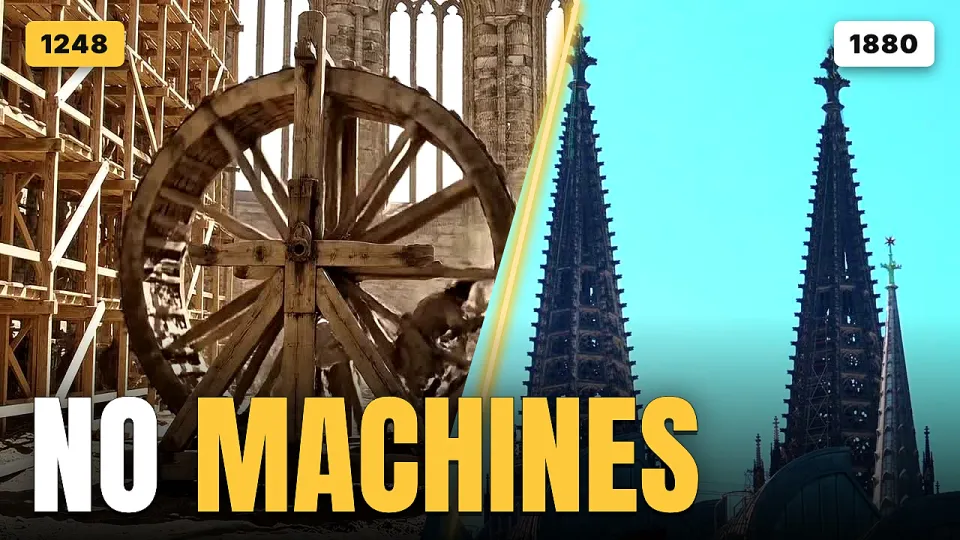
That figure is the reason the cathedral turns up on lists of the longest building projects in Europe. It is also slightly misleading. Split across the three phases, the timeline looks like this:
| Phase | Years | What happened |
|---|---|---|
| 1248–1473 | 225 years | Medieval building. Choir finished and completed 1322; south tower reaches about 59 m. |
| 1473–1842 | 369 years | Effectively nothing. A wooden crane sits on the unfinished south tower and becomes a city landmark. |
| 1842–1880 | 38 years | Nave, transepts and both west towers completed from the original medieval drawings. |
Actual construction time was therefore about 263 years. The other 369 years the building simply stood there, half-built, roofed over in stopgap fashion at the western end.
632 years, counted foundation stone to completion ceremony — 1248 to 1880. If you count only the years when masons were actually on site, the answer is closer to 263 years. Both numbers are correct; they answer different questions. The 632-year figure is the one carved into the cathedral's own story and the one you will see on plaques in Cologne.
Between 1248 and 1880. The Gothic choir — the eastern end, behind the high altar — was finished first, in 1322. Everything west of it, including the nave, the transepts and the twin towers, is 19th-century work built to medieval plans.
So a visitor standing inside is looking at two building campaigns six centuries apart, deliberately made to match. Our architecture guide covers how the joins were handled.
15 August 1248. Archbishop Konrad von Hochstaden laid the foundation stone for the new Gothic cathedral. The date was not accidental — it fell on a major feast day, and a fire earlier that same year had damaged the older cathedral standing on the site, which removed the main practical obstacle to replacing it. The design brief was ambitious from day one: match and surpass the great French cathedrals, above all Amiens.
15 October 1880, at a completion ceremony attended by Emperor Wilhelm I. That date closes the construction story, not the building work. Stone repair began almost immediately and has never stopped since.
Because building stopped for roughly 369 years. The medieval phase ran out of money and out of reasons. Pilgrim traffic to the Shrine of the Three Kings had funded much of the early work; as that income fell away and the city's priorities shifted, the cathedral chapter could no longer pay a full workshop. By about 1473 serious work had ceased, and the Reformation, later wars and the secularisation of church property gave nobody an incentive to restart it.
Three things brought it back in the 19th century:
Once those lined up, the remaining two-thirds of the building went up in 38 years.
There is no reliable number. Medieval building sites in Cologne kept no systematic record of workplace deaths, and no verified death toll was published for the 19th-century phase either. Figures that circulate online cannot be traced to a source, so this guide does not quote one. What is documented is that the work was dangerous — scaffolding, hoists and cut stone at 150 metres — and that the 19th-century cathedral works employed hundreds of men at a time.
Structurally, yes — it has been complete since 1880. Practically, no. A permanent in-house workshop of stonemasons, the Dombauhütte, works on the building year-round, cutting replacement blocks for stone that has weathered or been damaged. There is almost always scaffolding somewhere on the cathedral, which is why visitors' photos from different years rarely look the same.
There is an old Cologne saying that when the cathedral is finished, the world will end. Locals use it as a joke about the scaffolding. The wartime damage added decades to that repair backlog.
No single person. Archbishop Konrad von Hochstaden commissioned it in 1248. Master Gerhard was the first master builder. Nineteenth-century completion was led by cathedral architects Ernst Friedrich Zwirner and then Richard Voigtel.
The medieval phase passed through a succession of master builders. Master Gerhard began the choir; Master Arnold and, after him, his son Master Johannes carried it on through the late 13th and early 14th centuries. Below them worked the anonymous majority: quarrymen, carters, mortar mixers, carpenters, glaziers and the stonemasons whose personal marks are still visible cut into blocks inside the building.
The 19th-century phase was a state-and-public project. Zwirner ran the cathedral works from 1833 until his death in 1861; Voigtel took over and saw the towers topped out. The money came from Prussian state funds and from the Zentral-Dombau-Verein's public subscriptions — a rare case of a medieval cathedral finished by fundraising campaign.
There is no single architect. The design is High Gothic in the French tradition, closest to Amiens Cathedral, and Master Gerhard is credited with the choir — the part that sets the proportions for everything else.
The west front and the twin towers are the interesting case. They were built in the 19th century, but not to a 19th-century design: the medieval facade drawings had been rediscovered, so Zwirner and Voigtel executed a plan drawn some 500 years before they were born. That is why the building reads as one coherent design despite the gap. If you want the measured version — height, weight, records — see the facts page.
Planning to see it? Since 1 July 2026 tourist entry to the cathedral interior is ticketed — €12 regular, €6 reduced, free for under-14s. Full breakdown on our tickets page.
A Roman-era Christian church is built in Cologne, one of the oldest in Germany. Christianity had spread to the Rhineland during Roman occupation.
Archbishop Hildebald builds a new Carolingian cathedral, which serves as Cologne's main church for nearly 400 years.
A pivotal moment. Emperor Frederick Barbarossa transfers the relics of the Three Wise Men from Milan to Cologne. This transforms Cologne into a major pilgrimage destination and creates demand for a grander cathedral.
Archbishop Konrad von Hochstaden lays the foundation stone for the new Gothic cathedral. The design is based on French Gothic cathedrals like Amiens. Construction of the choir begins.
The choir (eastern end) is completed after 74 years of construction. The Shrine of the Three Kings is placed behind the high altar.
After 225 years, work stops. The south tower reaches 59 meters but remains unfinished. A large wooden crane sits atop the tower for the next 400 years, becoming a symbol of the city.
King Frederick William IV of Prussia provides funding to complete the cathedral. Romantic nationalism and the discovery of original medieval plans fuel enthusiasm to finish the Gothic masterpiece.
After 632 years, the cathedral is finally completed. Emperor Wilhelm I attends the ceremony. At 157 meters, the twin towers are the world's tallest structures (briefly).
The cathedral is hit by 14 aerial bombs. Despite extensive damage to the roof and windows, the main structure survives. Cologne's old town is 90% destroyed, but the cathedral stands.
Cologne Cathedral is inscribed as a UNESCO World Heritage Site, recognized as a masterpiece of Gothic architecture and a symbol of Christian faith.
Restoration work never stops. A permanent team of stonemasons, called the Dombauhütte, works continuously to maintain the sandstone structure. Over 6 million visitors come annually.
Following public debate, Cologne Cathedral introduces tourist admission: €12 regular, €6 reduced, with free tickets for children under 14. The revenue supports security, daily operations and conservation.
Up to 30 June 2026, Cologne Cathedral (Kölner Dom) — like most traditional places of worship in Germany — could be entered without a ticket. That changed on 1 July 2026: sightseeing visitors now pay a €12 entry fee (€6 reduced) to enter the cathedral interior. The information below explains how the building was paid for before that, and why the funding model changed.
The new tourist ticket system combines regular, reduced and free-child ticket categories:
Before this policy, the cathedral's massive daily operations were funded through three primary traditional channels:
Maintaining a colossal Gothic structure requires constant intervention. Skyrocketing security, daily operations, and structural restoration costs have reached an estimated €16 million per year—averaging about €44,000 per day.
Cathedral Provost Guido Assmann and administrator Clemens van de Ven noted that relying solely on traditional tax channels was no longer sustainable. Furthermore, church officials estimate that roughly 99% of the cathedral's visitors are there primarily for sightseeing rather than active worship. Charging a fee to these sightseers was deemed a necessary step to secure reliable, long-term financing.
The proposal to introduce entry fees was first announced in March 2026, triggering an intense public debate. Critics voiced concern over charging admission to a church, arguing that houses of God should always remain open without financial barriers. Supporters, including cultural affairs officers, countered that "overtourism" inflicts heavy physical damage on historic treasures, making a visitor contribution highly appropriate.
While the initial March proposal by architect Barbara Schock-Werner, head of the Central Cathedral Construction Association (ZDV), suggested a €10 price ceiling, the final rate was established at €12 in June 2026.
While a major shift for Cologne, this fee aligns the Kölner Dom with other iconic landmarks across Europe that charge admission to manage crowds and cover preservation. For comparison, Berlin's Cathedral charges a standard entry fee of €15, Barcelona's Sagrada Família charges €26, and Westminster Abbey in London charges £31 (approx. €36). The €12 fee ensures that the physical toll of overtourism is offset by resources dedicated to protecting the building.
Advertisement
The VR tour puts you in front of the cathedral at different points in its 632-year build. The cathedral interior needs its own €12 / €6 visitor ticket unless a listing says entry is included.
A guided walk around the outside of the cathedral. Virtual reality lets you jump between today and scenes from its 700-year history.
Check dates & pricesA guided walk through the historic Old Town, taking in the cathedral, the Hohenzollern Bridge and the Old Town Hall.
Check dates & pricesThe best view of the twin towers is from the river. A short panorama cruise past the city's landmarks.
Check dates & pricesPartner links: bookings go through GetYourGuide, and we may earn a commission at no extra cost to you. Cancellation terms are on each tour page.
Two earlier churches: a Roman-era church from the 4th century, one of the oldest in Germany, and the Old Cathedral (Alter Dom), a Carolingian building of around 870 AD under Archbishop Hildebald. It served for nearly 400 years until the Gothic cathedral was begun in 1248.
Building started in 1248, so the foundation is more than 775 years old, while the completed cathedral dates from 1880. See the facts page for height, age and records.
Yes, Cologne Cathedral was designated a UNESCO World Heritage Site in 1996. It was recognized as a masterpiece of Gothic architecture spanning from the Middle Ages to the 19th century.
Yes, it was hit by 14 bombs, causing significant damage to the roof and windows. Remarkably, the main Gothic structure survived. Restoration continued for decades after the war.
632 years of building fits in an afternoon at the kitchen table. These kits of the cathedral are popular with visitors as a souvenir or a gift.
179 foam pieces that slot together into a 35 cm model of the twin towers and nave. No glue or tools needed.
A 70 × 50 cm jigsaw of the cathedral from Ravensburger's Germany collection.
A fold-out card of the Cologne skyline with the cathedral at its centre. A small souvenir or a way to announce a trip.
Affiliate links. As an Amazon Associate we earn from qualifying purchases (Amazon.de, .co.uk, .com and .ca), at no extra cost to you. Prices and stock are set by Amazon. More kits, including brick sets: Cologne Cathedral model kits.