Dreikönigsschrein
Discover the largest medieval reliquary in the Western world - the magnificent golden shrine believed to contain the remains of the Three Wise Men who visited the infant Jesus.
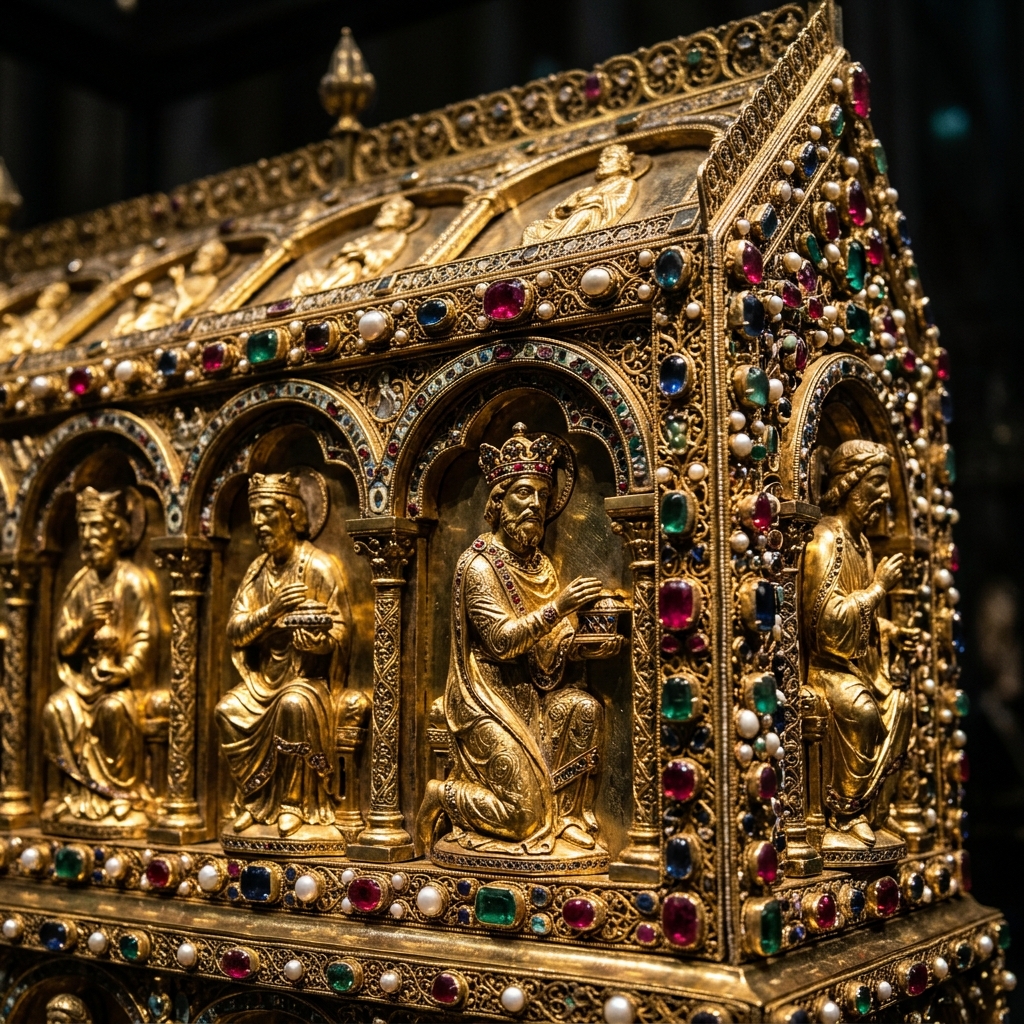
The Shrine of the Three Kings (Dreikönigsschrein in German) is a medieval reliquary that is the most precious artifact in Cologne Cathedral and one of the most important religious objects in Western Christianity.
Created between 1180 and 1225 by the master goldsmith Nicholas of Verdun and his workshop, the shrine is believed to contain the bones of the Three Magi (also known as the Three Wise Men or Three Kings) who, according to the Gospel of Matthew, followed a star to visit the newborn Jesus in Bethlehem.
The shrine is the largest gilded reliquary in the Western world, measuring approximately 220 cm (7.2 feet) long, 110 cm (3.6 feet) wide, and 153 cm (5 feet) high. It is shaped like a triple-naved basilica with a peaked roof and is covered in gold and silver gilt, adorned with approximately 1,000 precious stones, pearls, ancient cameos, and intricate religious imagery.
1180 - 1225
(45 years to create)
220 × 110 × 153 cm
(7.2 × 3.6 × 5 feet)
~1,000 gemstones
Gold, silver, pearls
According to tradition, the relics of the Three Kings were discovered in Persia by St. Helena, mother of Emperor Constantine. She brought them to Constantinople, the capital of the Eastern Roman Empire.
Bishop Eustorgius I of Milan received the relics as a gift and brought them to Milan Cathedral, where they remained for over 800 years.
A pivotal moment in history. Emperor Frederick Barbarossa gave the relics to Archbishop Rainald of Dassel, who brought them to Cologne in a grand procession. This transformed Cologne into one of medieval Europe's greatest pilgrimage destinations.
Master goldsmith Nicholas of Verdun began work on the magnificent reliquary shrine. The project would take over 40 years to complete, employing the finest craftsmen in Europe.
The foundation stone for the current Gothic Cologne Cathedral was laid. The cathedral was built specifically to house the Shrine of the Three Kings in a setting worthy of its importance.
The shrine remains in the choir of Cologne Cathedral, behind the high altar. It continues to be a major pilgrimage destination and draws over 6 million visitors annually to the cathedral.
The best day to see the shrine is January 6 (Feast of the Epiphany), when special celebrations honor the Three Kings. A Pontifical High Mass is held at 10:00 AM with the shrine as the focus.
Mark your calendar for the most significant day!
The Shrine of the Three Kings (Dreikönigsschrein) is a medieval reliquary located behind the high altar in Cologne Cathedral. Created between 1180-1225 by master goldsmith Nicholas of Verdun, it is the largest gilded medieval reliquary in the Western world. The shrine is believed to contain the bones of the Three Wise Men (Magi) who visited the infant Jesus Christ.
The remains inside the shrine are venerated by the Catholic Church as the relics of the Biblical Magi. According to tradition, the relics were discovered by Empress Helena in the 4th century and eventually transferred to Cologne in 1164. The Church does not require scientific verification of relics; they are objects of faith and devotion.
The Shrine of the Three Kings has a small viewing window that is occasionally opened. This typically occurs on the Feast of Epiphany (January 6th). The shrine itself is always visible during regular cathedral hours. The shrine was last opened for restoration between 2012-2014.
The shrine is made of gilded bronze, silver, and gold, adorned with around 1,000 precious stones including pearls, semi-precious gems, and ancient cameos. It measures approximately 220 cm long, 110 cm wide, and 153 cm high. It took craftsmen over 40 years to complete (1180-1225).
The shrine is one of Christianity's most important reliquaries and the primary reason Cologne Cathedral was built. The relics made Cologne one of medieval Europe's greatest pilgrimage destinations. The cathedral's construction began in 1248 specifically to house this shrine.
Discover the other remarkable artifacts