What is the Cologne Cathedral made of
Stone — three different stones, depending on which part you are looking at. The medieval fabric is mostly Drachenfels trachyte, a dark volcanic rock. The parts finished in the 19th century are Obernkirchen sandstone, which is much lighter. Repairs made today use Krensheim shell limestone. There is no brick and no concrete in the visible structure.
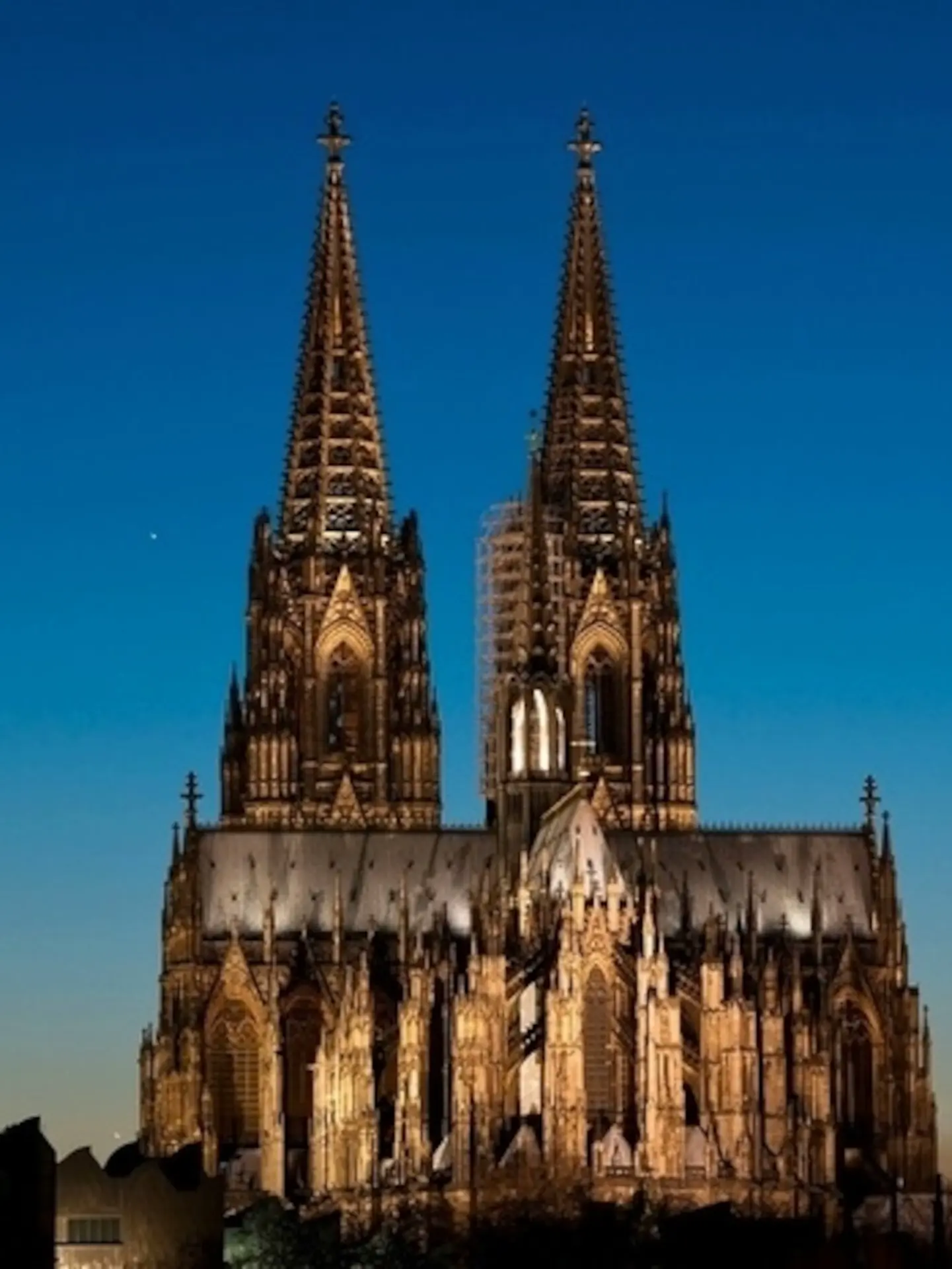
What materials were used to build the Cologne Cathedral
The build ran in two long phases separated by a gap of roughly 350 years, and each phase used whatever good stone was reachable at the time. That decision is still visible on the building today.
| Material | Era | Where it came from | Why it was used |
|---|---|---|---|
| Drachenfels trachyte | Medieval, 1248–1473 | Drachenfels mountain in the Siebengebirge, about 40 km south of Cologne | Hard volcanic stone, and close enough to move down the Rhine by boat |
| Obernkirchen sandstone | From 1842, when work resumed | Obernkirchen, Lower Saxony | The Drachenfels quarry was exhausted; this was the workable replacement |
| Krensheim shell limestone | Modern restoration, ongoing | Krensheim, southern Germany | Closely matches the original trachyte in colour and durability |
What material is the Cologne Cathedral made out of, section by section
If you stand on the Roncalliplatz side and look up, you can usually pick out the three stones by eye once you know what to look for.
- Darkest, roughest surfaces — medieval trachyte carrying centuries of crust.
- Lighter, more even blocks — 19th-century sandstone from the completion campaign, especially high on the towers and the nave.
- Pale, sharp-edged blocks — recent replacements. These look conspicuously new because they are.
The cathedral has its own permanent stonemasons' workshop, the Dombauhütte, which cuts and swaps damaged blocks continuously. The building is never actually finished, and the patchwork you see is maintenance in progress rather than neglect.
What about the windows?
The other material people notice is glass. The cathedral holds medieval glazing alongside 19th-century windows and Gerhard Richter's 2007 south transept window, which is made from thousands of squares of coloured glass. We cover those separately in the stained glass guide.
Frequently asked questions
What is Cologne Cathedral made of, in one sentence?
Cut stone — trachyte in the medieval parts, sandstone in the 19th-century parts, and shell limestone in modern repairs.
Is Cologne Cathedral made of brick?
No. The visible structure is cut stone throughout. This is why weathering shows up as a dark surface crust rather than crumbling brickwork.
Is it made of marble?
No. Marble appears only in fittings and decorative elements inside, not in the structure itself.
Why does the cathedral look two-toned?
Two reasons stack up: different eras used different stone, and cleaned or replaced blocks come back pale while untouched stone stays dark. We go into the discolouration in detail in why Cologne Cathedral is black.
Keep reading
- Why is Cologne Cathedral black? — the gypsum crust explained
- Cologne Cathedral architecture — floor plan, buttresses, Gothic structure
- Cologne Cathedral facts — height, age, and the numbers
- History of Cologne Cathedral — why the build stopped for 350 years